
Newsroom
How to choose a dry heat depyrogenation oven (DHS) for cGMP pharmaceutical manufacturing
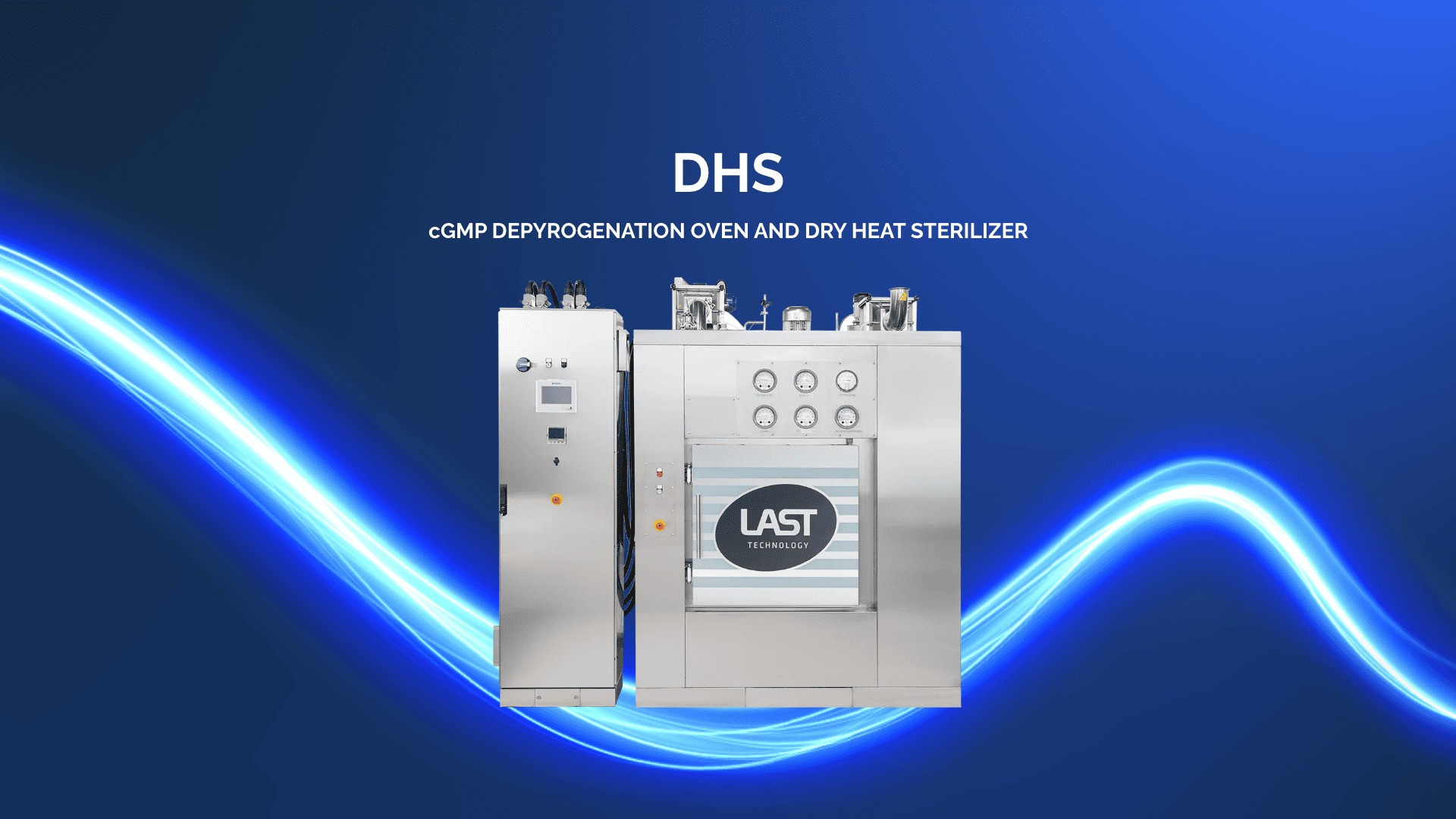
A dry heat depyrogenation oven prepares the glass and stainless steel components that come into contact with a sterile drug, and its specification shapes validation, throughput and cost for the life of the installation. In the industry these batch machines go by several names: dry heat sterilizer, DHS for short, depyrogenation oven or hot air sterilizer. What follows are the technical criteria that drive the choice, and how they are addressed in LAST Technology DHS ovens.
The process background, from pyrogens to the demonstration of endotoxin reduction, is covered in depyrogenation and DHS: methods and validation.
Batch oven or tunnel: the first decision
Dry heat depyrogenation runs on two architectures. A depyrogenation tunnel works continuously, linked upstream to the washer and downstream to the filling line. A static batch oven processes one load at a time on trolleys, with the doors closed, and unloads on the opposite side or the same side.
| Factor | Points to a tunnel | Points to a batch oven |
| Volume | High, continuous volumes of one container type | Medium or variable volumes, campaign production |
| Load variety | Few vial or bottle formats | Mixed formats, stainless steel parts, equipment |
| Integration | Linked washing, depyrogenation and filling line | Material flows separate from the line |
| Format changes | Rare, with acceptable changeover times | Frequent, handled with dedicated trolleys and cycles |
Even at high output, line speed, the number of formats and the flexibility required can tip the choice either way. The two architectures are also qualified differently: EU GMP Annex 1 treats tunnels and ovens separately, and for tunnels it lists belt speed or dwell time in the hot zone and pressure differential profiles along the tunnel among the critical parameters.
The DHS series belongs to the second architecture: LAST Technology builds static batch ovens only. The company’s solutions for this process are grouped on the depyrogenation process page.
The load as the basis for sizing
In dry heat, energy passes from the air to the surface of each item and from there inward: cycle length depends on the point of the load that reaches temperature last, usually the heaviest item or the one most shielded by others.
| Load variable | Effect on the cycle |
| Item types: vials, bottles, ampoules, stainless steel parts, equipment | Trolley layout and thermal behavior |
| Total mass per cycle and mass of the heaviest item | Heat-up and cool-down times |
| Carriers: baskets, trays, covers | Added mass and possible obstruction of airflow |
| Minimum and maximum load patterns | Aspects to cover in qualification under Annex 1 |
| Worst-case load and expected future loads | Basis of validation; a new load may require requalification |
DHS ovens are designed for empty glass containers such as bottles and vials, and for stainless steel parts. Trolleys run on height-adjustable guides at the bottom of the chamber. Chamber size is defined around the load to be treated: the only constraint is a minimum chamber volume of 300 liters (about 10.6 cu ft).
Example: a new load at a site with a tunnel
The situation. A site runs a depyrogenation tunnel linked to its filling line. The tunnel handles a single vial format.
The change. Two new loads are now needed: stainless steel parts from the filling machine and small batches of bottles for clinical trials.
The problem. The tunnel is not qualified for these loads, and using it would mean frequent line stops for format changes.
A possible solution. A batch oven with pass-through doors, qualified for the new loads, treats parts and bottles separately, without stopping the line.
Throughput and total cycle time
The real capacity of an oven depends less on nominal chamber volume than on four quantities:
- effective capacity per cycle: the number of containers or parts in the validated load pattern
- total cycle time: loading, heat-up, exposure, cool-down and unloading; with heavy loads, cool-down can take as long as exposure
- cycles per shift: available time divided by total cycle time, net of the activities between cycles
- process fit: oven output relative to the washer upstream and the filling demand downstream
Since times and capacity change considerably from one load to another, energy consumption is only meaningful when measured on a representative load. LAST Technology provides customers with energy consumption measured with the oven loaded.
What drives the cost of a depyrogenation oven
Two ovens with the same chamber volume can differ widely in price. The difference usually comes from scope rather than from the chamber itself:
- single-door or pass-through configuration, and the cleanroom wall interface
- air class guaranteed through every phase of the cycle, including cool-down
- chamber construction, materials and internal surface finish
- control system, data integrity functions and software documentation
- scope of the qualification package, from design qualification to PQ assistance
- degree of customization to the load and the layout
- lifecycle costs: maintenance, spare parts, filter replacement and periodic requalification
On DHS ovens, data integrity functions are standard, and every oven is supplied with its spare parts list and preventive maintenance plan.
Cycle objective: sterilization or depyrogenation
A dry heat oven can run cycles with two objectives. Sterilization inactivates microorganisms. Depyrogenation destroys bacterial endotoxins, which are far more heat resistant and need higher temperatures or longer exposure. The distinction is covered in detail in the guide on the differences between sterilization and depyrogenation.
For depyrogenation, EU GMP Annex 1 requires validation studies showing a suitable Fh value and at least a 3 log10 reduction in endotoxin concentration. Once this is demonstrated, sterilization does not need to be proven separately. Validation uses containers spiked with endotoxin that are representative of the materials normally processed, with full reconciliation and a demonstration of recovery. The United States Pharmacopeia chapter on dry heat depyrogenation, USP <1228.1>, also refers to a 3 log reduction. Which references apply depends on the destination market of the product.
On DHS ovens, depyrogenation cycles run between 250 °C and 300 °C (482 °F to 572 °F). The same ovens also run hot air sterilization cycles, between 150 °C and 180 °C (302 °F to 356 °F). Cycles are either predefined or custom, and are developed by the LAST Technology automation department according to the applicable standards and the items to be treated.
Critical parameters under EU GMP Annex 1
For dry heat ovens, EU GMP Annex 1 (2022 revision, sections 8.66 to 8.70) sets two general conditions:
- positive pressure: the chamber must stay at positive pressure relative to lower grade areas throughout the cycle and the post-cycle hold, unless the packaging of the load preserves its integrity
- HEPA filtration: all air entering the oven must pass through a HEPA filter
It then lists the critical parameters to consider in qualification and routine operation:
| Critical parameter | What it involves |
| Temperature | Operating range, measuring points and recording for each cycle |
| Exposure time | Condition from which timing starts and how it is measured |
| Chamber pressure | Overpressure maintained during cool-down as well |
| Air speed | Design value and its verification method |
| Air quality in the chamber | Class to be maintained in every phase of the cycle |
| Heat penetration | Identification of the slowest-to-heat points in the load |
| Heat distribution and uniformity | Permitted deviation and measuring conditions |
| Load pattern | Minimum and maximum load patterns to be qualified |
On DHS ovens, air speed is a design value, while chamber pressure is measured and included in the report.
Chamber air class through the whole cycle
For glass going to aseptic filling, the requirement concerns how the air class holds in every phase of the cycle, not only its nominal value. The reference is ISO 5 under ISO 14644-1, often still called Class 100 after the withdrawn US Federal Standard 209E.
DHS ovens are designed to maintain Class 100 throughout the cycle, up to 300 °C (572 °F): heat-up, sterilization or depyrogenation, and cool-down. Cool-down is the most critical phase, because frames and filters expand with heat and contract as temperature falls, and that movement can release particles. Chamber air class is a qualification test: it is verified during IQ and OQ by sampling particle levels across the whole cycle, with particular attention to cool-down.
DHS ovens use H13 or H14 HEPA filters, depending on the customer’s requirements. They are installed in three positions:
- supply air: filters the air entering the oven
- filter wall: covers the entire side section of the chamber, behind the perforated wall through which air enters the chamber
- exhaust air: filters the air leaving the oven
The number of filters in each position depends on the size of the chamber.
Heat uniformity and readiness for mapping
Good uniformity narrows the gap between the hottest and coldest points of the load and leaves room to optimize the cycle, whose times are still set by validation on the actual load.
In DHS ovens, uniformity rests on specific design choices:
- the recirculation system sits at the top of the oven, with heating elements and cooling exchanger arranged concentrically around the fan impeller
- air enters the chamber through perforated walls with holes of different diameters, larger toward the bottom and smaller toward the top
- a jacketed chamber floor speeds up and evens out heating and cooling of the load
The stated temperature deviation during sterilization and depyrogenation is below ±2 °C (±3.6 °F), measured with the chamber empty.
For validation, three 1.5″ tri-clamp ports are welded onto the DHS chamber: they are used for particle sampling and temperature uniformity mapping, without passing probes through the door gaskets.
Cleanroom integration and layout
In most installations the oven separates two areas: the loading side, where washed material arrives, and the unloading side toward the aseptic area. A pass-through, double-door configuration keeps treated material out of the path of untreated material. On double-door DHS ovens the doors are interlocked: while one is open, the other cannot be opened. A single-door version is also available. In both versions the doors stay locked until conditions inside the chamber are safe, for example while the temperature is above the set safety value.
On DHS ovens, both doors are prepared for connection to cleanroom walls through a bio-seal interface, which seals the gap between machine and wall. The chamber can be installed above floor level, on a tubular base that spreads the weight evenly, or in a pit.
The project also defines:
- cleanroom grades on both sides and wall thickness
- machine footprint and technical space for maintenance
- utilities: electrical power, cooling water, compressed air, any exhaust. For DHS ovens, utility requirements and consumption are provided at quotation stage for the specific size
- floor loading and trolley routes on both sides
Chamber construction and cleanability
In a chamber running at 300 °C and unloading toward the aseptic area, cleanability and the absence of spots where particles can accumulate are design requirements.
DHS chambers and doors have a rectangular section. The chamber is made of AISI 316L stainless steel as a single, fully welded piece, with rounded corners that make the internal surfaces easier to clean. The mechanical construction withstands temperatures above 350 °C (662 °F). Internal surfaces are mechanically polished, then degreased, pickled and passivated, with a surface roughness of Ra ≤ 0.35 µm.
Request a technical assessment of your depyrogenation process
The LAST Technology engineering team assesses each project starting from the load, the required throughput and the layout. To describe your case, write to info@lasttechnology.it.
Automation, recipes and data integrity
The control system determines how cycles are managed and what is documented. Requirements depend on the market and on the site quality system, and typically cover:
- recipe management with differentiated access levels
- recording of temperatures, times, pressures, alarms and events for each cycle
- audit trail of parameter changes
- electronic records and signatures, where the site applies FDA 21 CFR Part 11 or EU GMP Annex 11
- integration with the plant manufacturing execution system (MES)
- software documentation consistent with a GAMP 5 approach
For its machines, LAST Technology lists software functions for data integrity in line with 21 CFR Part 11, integration with the customer’s MES and documentation according to GMP and GAMP 5. On the DHS these functions are standard. Machine functions support compliance, which for the computerized system also depends on the site’s procedures and validation.
Machines placed on the European market must also meet the new EU Machinery Regulation (EU) 2023/1230, which applies from 20 January 2027 and includes requirements on the safety of control systems.
Qualification, validation and lifecycle support
Beyond the machine, the supply includes support through commissioning, qualification and maintenance of the qualified state.
During the project
| Stage | Where | What it includes |
| DQ and risk analysis | Design phase | Traceability between user requirements and design choices |
| FAT, factory acceptance test | At the manufacturer, on site or remote | Tests on the machine according to protocol |
| SAT, site acceptance test | At the customer site | Start-up, tests after utility connection, training |
| IQ and OQ | At the customer site | Installation and operational verification, including the chamber air class test |
| PQ | At the customer site | Assistance on real loads |
The services listed by LAST Technology include design qualification, risk analysis, definition of the commissioning and qualification strategy, on-site or remote FAT, SAT with start-up and training, IQ and OQ activities and PQ assistance. All of them are available for the DHS.
The qualification program typically covers temperature distribution, heat penetration into the load, particle counts during the cycle, filter integrity and verification of endotoxin reduction with spiked containers and a bacterial endotoxin assay, such as the LAL test. The test method and its acceptance criteria are defined in the validation protocol.
After installation
Load studies are repeated at periodic requalification and with every significant change to the load, while filters, probes and gaskets need planned maintenance. With every DHS, LAST Technology always supplies the spare parts list and the preventive maintenance plan. Its services also include regular maintenance, 24/7 remote support and support for periodic requalification.
What can be customized
In a custom-engineered oven, the chamber is built around the load and the layout, with fewer compromises to manage later in validation. On DHS ovens, customization covers the cycles, with predefined programs and programs developed for the items to be treated, as well as chamber dimensions, machine layout and trolley types. Benefits and qualification implications are discussed in the article on customized pharmaceutical machinery.
Summary: requirements and documentation
The criteria covered in this article, with the documentation that goes with them.
| Requirement | How it is documented |
| Architecture: batch oven or tunnel | Analysis of volumes, formats and line integration |
| Reference, minimum, maximum and worst-case loads | Load patterns for qualification |
| Throughput per shift | Total cycle time on the reference load |
| Cycle objective and endotoxin reduction | Validation protocol with spiked containers |
| Overpressure and air speed | Design values and pressure recording in the report |
| ISO 5 in every phase, including cool-down | Particle sampling in IQ and OQ |
| Temperature uniformity | Temperature mapping, with stated value and measuring conditions |
| Cleanroom integration | Layout drawings, wall interface, utilities |
| Construction and finishes | Material and surface finish certificates |
| Data integrity | Audit trail functions and software documentation |
| Qualification and lifecycle | Qualification documents, spare parts list and maintenance plan |
Key takeaways
What sets one depyrogenation oven apart from another is sizing on the real load, compliance with the Annex 1 critical parameters, air class in every phase, heat uniformity, cleanroom integration and the qualification path.
The features of the LAST Technology DHS series are described on the DHS depyrogenation oven and cGMP dry heat sterilizer page. For a technical assessment of your process, write to info@lasttechnology.it; the full catalog can be requested from the website.

FAQ - Frequently asked questions
Yes. Under EU GMP Annex 1, when validation shows a suitable Fh value and at least a 3 log10 endotoxin reduction, no separate demonstration of sterilization is required. DHS ovens can also run sterilization-only cycles, between 150 °C and 180 °C, which have their own parameters and validation.
Related posts

mail
Subscribe to our newsletter
Stay up to date with the latest news from LAST Technology