
Newsroom
VHP decontamination in pharmaceutical manufacturing: how it differs from aerosolized H2O2 and gas plasma
In brief
- Vaporized hydrogen peroxide (VHP, also written VPHP or VH2O2) is a low-temperature process used for the validated biodecontamination of exposed surfaces in enclosed chambers, isolators and pharmaceutical transfer systems.
- VHP is not the same technology as hydrogen peroxide gas plasma. Gas plasma applies an additional energy field to the vapour, which places it in a different equipment category with a different regulatory scope.
- In cGMP pharmaceutical manufacturing, VHP is widely used to biodecontaminate the exposed surfaces of heat-sensitive materials transferred between areas with different contamination-control requirements.
What is VHP decontamination?
Hydrogen peroxide (H2O2) is an oxidizing agent. Its antimicrobial action comes from reactive oxygen species, including hydroxyl radicals, which can damage cellular membranes, proteins, enzymes and nucleic acids. Because several cellular targets are affected at once, the process is broad-spectrum against bacteria, yeasts, moulds, viruses and bacterial spores. The efficacy actually achieved, however, depends on the validated cycle, the challenge organism, the load and the exposure conditions, not on the agent alone.
In a VHP process, a liquid hydrogen peroxide solution is vaporized and introduced into a closed chamber or enclosure. The vapour is distributed over exposed surfaces, held for a defined exposure period, and then removed and catalytically converted.
Two characteristics make the process relevant in a regulated environment. The main decomposition products are water and oxygen, so no persistent chemical residue is left behind. And the process runs at low temperature, which is what allows it to be applied to materials that saturated steam or dry heat would damage.
Residual hydrogen peroxide may remain temporarily adsorbed on surfaces or absorbed into load materials after exposure. This is why a controlled aeration phase and a validated release criterion are part of the process rather than optional refinements.
How a VHP biodecontamination cycle works
A VHP cycle commonly includes conditioning, hydrogen peroxide injection, exposure and aeration. The exact terminology, sequence and duration depend on the generator, the chamber design, the process-control strategy and the validated load. Different manufacturers describe the same physical process with different phase names, so cycle descriptions are not directly comparable between systems.
Conditioning
The chamber atmosphere is brought to a defined and repeatable starting point before injection begins. Where dehumidification is applied, the purpose is to control the margin to saturation, since excess water vapour competes with hydrogen peroxide for surface adsorption and narrows the window before condensation occurs.
Hydrogen peroxide injection
The solution is vaporized and introduced at a controlled rate until the target chamber condition is reached.
Uniform distribution is influenced by airflow, load geometry, surface absorption and the presence of shadowed or enclosed areas. Hydrogen peroxide vapour does not distribute as readily as a true gas, so coverage depends on how the chamber circulates it rather than on the agent finding its own way around the load. For this reason, load configuration and internal circulation are part of cycle development and validation, not operator discretion.
The DPB chambers, LAST Technology’s bio-decontamination pass-boxes, address this through internal forced ventilation, rounded internal corners and a mechanically polished surface finish that reduces the shadowed areas where vapour struggles to reach.
Exposure
The chamber is held at the target condition for the time required to achieve the reduction defined for the intended use. This is the phase that delivers the lethality and the phase that cycle development is designed to establish.
Aeration
Residual hydrogen peroxide is removed from the chamber and passed through a catalytic converter, which breaks it down into water and oxygen. Aeration continues until the measured concentration falls below the release criterion defined for the equipment, at which point the load can be handled.
Aeration is often the longest phase of a VHP cycle, particularly with absorbent loads. Hydrogen peroxide absorbed into polymeric and cellulosic materials during exposure desorbs slowly afterwards, so a load rich in plastics will aerate more slowly than a load of stainless steel components under identical settings. This is a load effect rather than an equipment defect.
The release criterion is set for the specific equipment and measurement point. An occupational exposure limit such as the OSHA 8-hour TWA of 1 ppm is a workplace air standard and is not automatically the door-release setpoint of a chamber.
VHP versus aerosolized hydrogen peroxide
Aerosolized hydrogen peroxide (aHP) delivers the agent as fine liquid micro-droplets produced by a nebulizer, rather than as a vapour generated by a phase change.
The practical differences follow from the physical state. Droplets settle and wet surfaces, which affects electronics and any load sensitive to liquid contact. Distribution follows the airflow that carries the droplets, and coverage in complex geometries can be less predictable. aHP formulations frequently contain additives such as silver ions or peracetic acid, which improve efficacy but also mean that the decomposition profile is not simply water and oxygen.
aHP is most commonly applied to rooms and facilities. VHP is used across a wider range of scales, from small transfer chambers up to entire suites, and is the more established option where a chamber-based, repeatable and validatable cycle is required.
A further category is sometimes described as ionized hydrogen peroxide (iHP), in which a low-concentration solution is passed through a cold plasma arc to generate reactive species. It is worth knowing the term, but the category is largely proprietary and not uniformly defined across suppliers, so it is not directly comparable with VHP or aHP on a like-for-like basis and is not included in the comparison table below.
VHP versus hydrogen peroxide gas plasma
This is the most persistent confusion in the field, and it is worth stating plainly.
In a VHP process, the active agent is hydrogen peroxide vapour itself. No additional energy field is applied. The vapour is generated, distributed, held for the exposure period and then catalytically removed.
In a hydrogen peroxide gas plasma process, the vapour is subsequently excited by a radiofrequency or microwave field, producing a low-temperature plasma containing free radicals and charged species. The plasma phase adds a further oxidative mechanism and assists in breaking down residues at the end of the cycle.
Three differences matter in practice.
The energy field: This is what defines the two categories. In gas plasma the vapour is excited by an external field; in VHP it is not. Everything else follows from this.
Scale: VHP runs from a small transfer chamber up to an entire suite. Gas plasma remains tied to chambers of modest volume.
Intended use and claim: meaning what the manufacturer states the process achieves and has to demonstrate with validation data. Gas plasma is associated with the sterilization of reusable medical devices. VHP in pharmaceutical settings is associated with the biodecontamination of exposed surfaces.
One clarification is worth making, because it is a frequent source of confusion:
The pressure regime does not distinguish the two technologies.** Many VHP systems operate at atmospheric or slightly negative pressure, but VHP cycles are also run under vacuum, and vacuum introduces no plasma phase. Pressure and energy field are independent variables: the first is a process choice, the second determines which category the equipment belongs to. The DPB series is a VHP process. No configuration includes a plasma phase.
Comparison of low-temperature methods
| VHP / VH2O2 biodecontamination | Aerosolized H2O2 (aHP) | H2O2 gas plasma and low-temperature medical-device systems | Ethylene oxide | |
| Intended use | Surface biodecontamination of enclosures, isolators and transfer chambers in pharma and biotech | Room and facility disinfection | Sterilization of reusable medical devices | Terminal sterilization of packaged devices and materials |
| Energy field applied to the agent | None | None | Radiofrequency or microwave | None |
| Physical delivery | Vapour generated by phase change | Liquid micro-droplets from a nebulizer | Vapour plus plasma-generated reactive species | True gas |
| Typical feed solution concentration | Commonly in the region of 30 to 35% | Commonly single digit to low double digit percentage, often with additives | System specific | Pure or diluted gas |
| Pressure regime | Atmospheric, slightly negative or vacuum depending on the configuration | Atmospheric | Frequently vacuum | Sub-atmospheric |
| Operating temperature | Low, near ambient. DPB operates between 20 and 30 °C | Ambient | Low temperature, system dependent | Typically 30 to 60 °C |
| Surfaces addressed | Exposed surfaces within the validated load configuration | Exposed surfaces, with wetting | Device surfaces and lumens within the validated claim | Penetrates compatible packaging |
| Aeration | Required, duration strongly load dependent | Required, wetting extends drying | Managed within the cycle | Extended degassing with residue limits |
| Material limits | Cellulose and some polymers may absorb or degrade; requires qualification. Not applicable to liquids | Wetting risk on electronics and sensitive surfaces | Not suitable for cellulose or liquids | Absorbs into polymers, requires degassing |
| Validation claim | Defined and justified microbial reduction on exposed surfaces | Formulation and system dependent | Sterilization claim under the applicable standard | Sterilization claim under the applicable standard |
*Note. The feed solution concentration describes what enters the vaporizer or nebulizer. It does not define the concentration achieved inside the chamber, nor process performance, both of which depend on injection profile, chamber volume, temperature and load.*
Biodecontamination versus sterilization
The two words are not interchangeable, and the distinction is about the claim rather than about the agent.
Biodecontamination describes a validated reduction of microbial contamination on exposed surfaces, to a level defined and justified for the intended use. It is the term normally applied to pharmaceutical pass-boxes, isolators and enclosure decontamination.
Sterilization describes a process validated to deliver a specified sterility assurance level under an applicable standard, within a defined regulatory scope.
Low-temperature vaporized hydrogen peroxide sterilization of medical devices is addressed by ISO 22441. That standard applies to medical-device sterilization processes and does not cover room, enclosure or environmental decontamination systems, so it defines the boundary rather than describing pharmaceutical transfer applications.
Several other standards are relevant to the wider field. ISO 14937 is generic to sterilizing agents and sets out the development, characterization, validation and routine control of a sterilization process. ISO 11138-6 covers biological indicators for use with vaporized hydrogen peroxide processes, and is therefore the reference when log reduction is being evaluated. EN 17180, which addresses low-temperature VH2O2 sterilizers for medical purposes, is at draft stage at the time of writing and, like ISO 22441, excludes environmental and room decontamination systems from its scope.
For the broader distinction between sterilization and other cGMP processes, see the LAST Technology guide on sterilization and depyrogenation.
Critical process parameters
Repeatability in a VHP cycle depends on a limited set of parameters. These are what cycle development defines, what the control system holds and what the batch record demonstrates.
- Hydrogen peroxide concentration or injection profile
- Chamber temperature and relative humidity
- Saturation margin and condensation-control strategy
- Exposure time
- Airflow and distribution within the chamber
- Pressure regime
- Load mass, geometry and absorbency
- Residual hydrogen peroxide release criterion at the end of aeration
A change to any of these can move the outcome, which is why load patterns and cycle parameters are controlled documents rather than settings adjusted at the machine.
Efficacy and cycle validation
In pharmaceutical practice, efficacy is demonstrated with biological indicators rather than inferred from concentration and time.
Biological indicators containing a defined population of resistant spores are commonly used during VHP cycle development and qualification. A challenge population of 10⁶ spores is frequently applied, but the required reduction and the acceptance criteria must be scientifically justified for the intended use, the load configuration, the Contamination Control Strategy and the validated transfer process. There is no single regulatory figure that applies to every pass-box and every application.
Indicators are placed at the positions that cycle development identifies as worst case, typically shadowed areas, load interiors and points furthest from the vapour inlet.
A common approach to cycle development, though not a universal requirement, is to map the chamber to identify difficult positions, run reduced-exposure or fractional cycles to characterize the lethality curve, and then confirm the full cycle under nominal parameters. Routine control afterwards depends on sensor calibration, process recording, periodic requalification, change control and deviation management.
This is also why the reduction a chamber can demonstrate is not a catalogue figure. It follows from the validated cycle, the load configuration and the biological indicator used, and it is established during cycle development together with the customer’s quality function.
Material compatibility and practical limits
An accurate account of VHP has to include what the process does not do well.
Absorption into porous materials. Cellulose in particular can absorb hydrogen peroxide readily, which may deplete chamber concentration during exposure and extend aeration afterwards. Paper documentation, cardboard and cellulose-based packaging are commonly excluded from VHP loads.
Polymer behaviour. Some polymers can degrade under repeated exposure. Compatibility should therefore be qualified for the cumulative number of cycles a material will actually see, not for a single exposure.
Condensation control. If the chamber atmosphere exceeds the saturation point for the given temperature, hydrogen peroxide condenses as liquid. Micro-condensation is regarded by part of the industry as contributing to lethality and by another part as a process deviation to be controlled. What is not disputed is that uncontrolled macro-condensation lengthens aeration and can damage the load.
Enclosed geometries. Vapour reaches surfaces it can circulate over. In a pharmaceutical VHP pass-box, the validated claim normally applies to exposed external surfaces within a defined load configuration. Wrapped, nested or closed items must not be assumed to be internally decontaminated unless this has been specifically demonstrated and included in the validated claim.
Vacuum as a process variant
The limitation described above, the difficulty vapour has in reaching cavities and closed geometries, has a specific technical answer: running the cycle under vacuum rather than at close to atmospheric pressure.
The mechanism is straightforward: Air inside the chamber occupies volume and obstructs contact between the vapour and the surfaces. Removing it before injection produces two effects. The chamber saturates more uniformly with hydrogen peroxide vapour, because there is no longer a competing gas diluting it. And the vapour permeates more readily into cavities and into loads whose geometry traps pockets of air, where at atmospheric pressure surface contact remains partial.
It remains a VHP process in every respect. No energy field is applied, the agent is still hydrogen peroxide vapour, and the decomposition products are still water and oxygen. What changes is how the vapour reaches the load, not the nature of the process.
Vacuum is not universally preferable, however. It requires a chamber built to withstand the pressure differential, which affects achievable dimensions and cost, and not every load tolerates the pressure change. For material transfers with simple geometries, an atmospheric cycle remains the proportionate solution.
Which regime applies depends on the load. Where accessible external surfaces predominate, an atmospheric configuration is sufficient. Where the load presents cavities, internal volumes or geometries that trap air, vacuum widens what can be treated repeatably.
Where VHP fits in an Annex 1 transfer strategy
The recurring problem in a sterile manufacturing facility is not decontaminating a material in isolation. It is moving that material from a lower grade area into a higher grade area without carrying bioburden across the boundary.
EU GMP Annex 1 requires that the transfer of materials into and out of classified areas be one of the controlled elements of the Contamination Control Strategy, with the method selected and justified for the materials involved. Where the material cannot be sterilized, a validated surface biodecontamination step supported by a defined transfer procedure is one of the recognized approaches.
VHP fits this requirement because it works at low temperature on materials that no thermal process could survive, and because a chamber with interlocked doors enforces the directional flow between zones as part of the same operation.
The detailed requirements of Annex 1 qualification are outside the scope of this article. What matters here is that the biodecontamination step is one element of a documented strategy, not a substitute for it.
VHP pass-boxes in pharmaceutical material transfer
Plastic syringe trays, electronic components, pre-sterilized single-use items, sealed containers of disinfectant and packaged consumables cannot pass through an autoclave or a dry heat oven. A chamber-based VHP process addresses both requirements at once: surface biodecontamination at low temperature, and controlled directional transfer through interlocked doors.
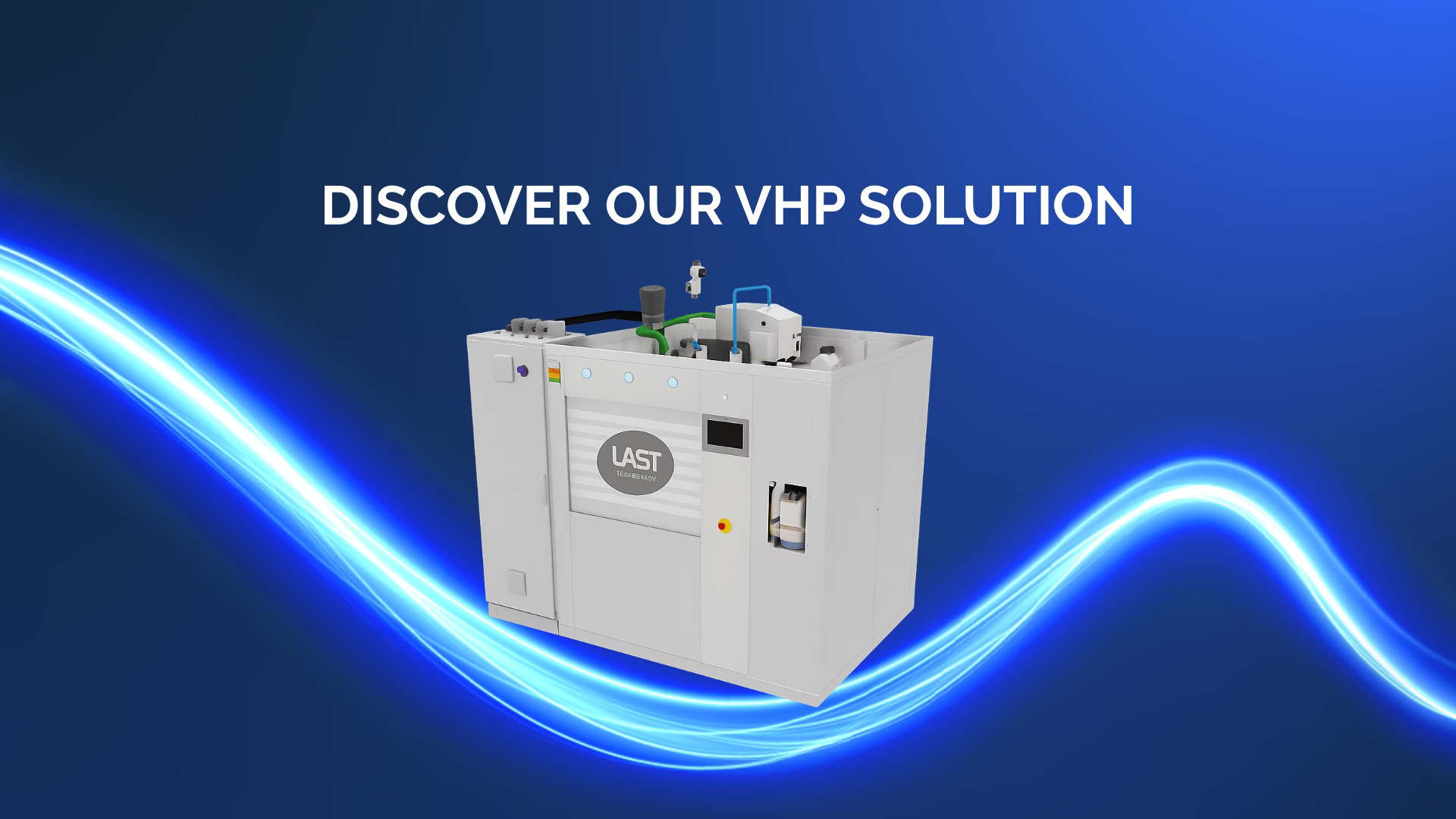
This is the function of the DPB cGMP bio-decontamination pass-boxes, which operate on air and hydrogen peroxide between 20 and 30 °C. Four design elements are directly relevant to the process described above: internal forced ventilation for distribution, catalytic conversion during aeration, interlocked doors for directional transfer, and a bio-seal interface designed to connect the discharge side to the cleanroom wall.
Full construction specifications, configurations and dimensions are on the product page.
For the broader category of pharmaceutical decontamination systems, see the decontamination process page.
When VHP is not the appropriate technology
VHP does not replace the thermal processes, and presenting it as a general-purpose alternative would be misleading.
It is not applicable to liquids: Hydrogen peroxide vapour acts on exposed surfaces. Penetration into a liquid volume is insufficient and uneven, and cannot support a claim over the volume itself.
Where the load tolerates heat and moisture, and particularly where porous items require penetration, saturated steam sterilization remains the reference process.
Where the requirement is terminal sterilization of packaged devices and materials that cannot tolerate any thermal process, ethylene oxide sterilization penetrates compatible packaging in a way that vapour-phase hydrogen peroxide does not.
The selection starts with the load, the boundary it has to cross and the claim that has to be demonstrated.
Summary
Hydrogen peroxide is one agent applied in several different ways, and the differences are not cosmetic. Vaporized hydrogen peroxide is a low-temperature vapour-phase process, used in pharmaceutical manufacturing for validated biodecontamination of exposed surfaces in chambers, isolators and controlled environments. Aerosolized hydrogen peroxide delivers droplets rather than vapour, with different wetting and distribution behaviour. Gas plasma excites that vapour with an added energy field and belongs to the medical-device sterilization category. The pressure regime is a separate question: VHP itself runs at atmospheric pressure or under vacuum depending on what the load requires.
Selecting correctly starts with three questions: what is the load, which boundary does it have to cross, and what claim has to be demonstrated. The agent follows from the answers, not the other way round.
How LAST Technology approaches VHP biodecontamination
LAST Technology designs and manufactures cGMP and cGLP process equipment for the pharmaceutical, biotechnology and life science industries, with installations in more than fifty countries. Every machine is engineered around the customer’s process rather than adapted from a fixed catalogue configuration.
Applied to vaporized hydrogen peroxide, that principle affects three things. Chamber volume and internal geometry follow the load that will actually be transferred, not a standard size. The discharge side is built to interface with the specific wall construction and cleanroom grade of the installation. And cycle parameters are developed against the reference load defined with the customer, rather than supplied as a generic default.
The equipment provides a controlled, repeatable and fully recorded process. The reduction claim, the load pattern and the acceptance criteria are established together with the customer’s quality function, because they depend on the intended use rather than on the machine alone.
If you are specifying a transfer chamber for thermolabile materials, you can review the cGMP VHP pass-box specifications or contact our engineering team to discuss a configuration.
At CPHI Milan 2026
LAST Technology presents its vacuum VHP configuration at CPHI Milan 2026, 6 to 8 October, Fiera Milano.
Technical references
- European Commission, EU GMP Annex 1, Manufacture of Sterile Medicinal Products
- ISO 22441, Sterilization of health care products, low temperature vaporized hydrogen peroxide
- ISO 14937, Sterilization of health care products, general requirements for characterization of a sterilizing agent and the development, validation and routine control of a sterilization process
- ISO 11138-6, Sterilization of health care products, biological indicators for vaporized hydrogen peroxide sterilization processes
- EN 17180 (draft), Sterilizers for medical purposes, low temperature vaporized hydrogen peroxide sterilizers
- CDC, Hydrogen Peroxide Gas Plasma
- FDA, Vaporized Hydrogen Peroxide for Medical Device Sterilization
OSHA, Hydrogen Peroxide chemical data and exposure limits

FAQ - Frequently asked questions
It depends on the claim and the validation supporting it. In pharmaceutical manufacturing the process is normally described as biodecontamination, targeting a justified reduction on exposed surfaces. Low-temperature vaporized hydrogen peroxide processes for medical devices, validated under the applicable standard, do carry a sterilization claim.
Related posts


mail
Subscribe to our newsletter
Stay up to date with the latest news from LAST Technology